
Special Processes
Special Processes
Strainsert offers a wide range of special processes that are available for most of our custom Force Sensors. All special processes, along with traceable parts/domestic materials requirements, specific approved vendors or sources, flow downs requirements, Terms and Conditions, and/or other special requirements must be provided during the inquiry stage of our custom design process for cost evaluation and lead time accuracy.
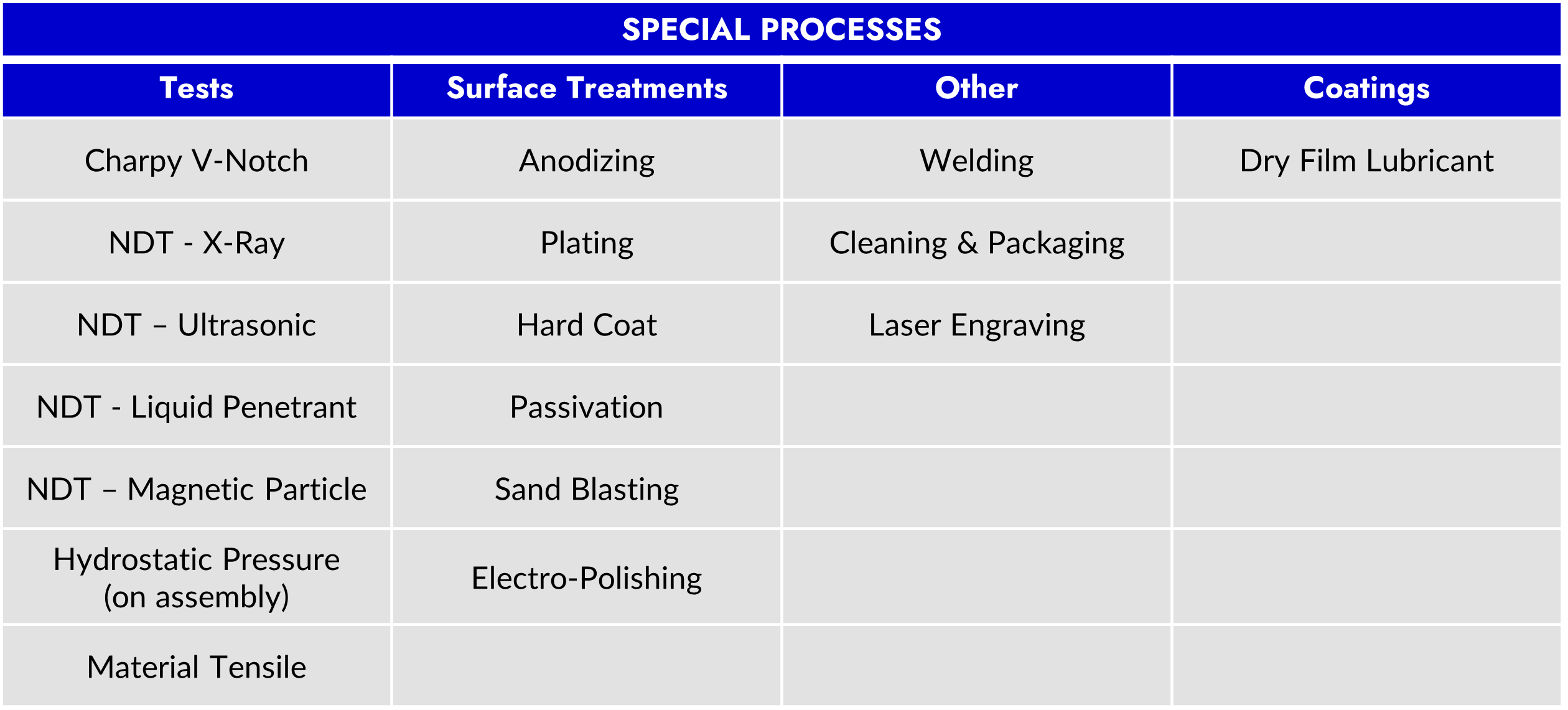
These special processes include a number of different tests, coatings and surface treatments based on customer specifications and requirements. Review the table below of the most common processes Strainsert offers for custom force sensors.
The special processes are most frequently selected for our Custom Force Sensors used in aerospace, military & aviation applications. There are many important reasons to use these processes; listed below are several of the most critical.
1. Many of our Force Sensors used in aerospace, aviation & military applications operate in extreme environments, facing severe temperature fluctuations, intense vibration, rapid pressure changes, and high magnitude loading conditions. Special processes are utilized to mitigate the impact of those conditions on sensor measurement performance and operational life expectancy.
2. Aircraft and other vehicles containing force sensors are exposed to moisture, salt spray (especially over oceans), and de-icing chemicals. Without proper surface treatment, corrosion is a problem and corrosion on flight-critical parts can be catastrophic.
3. Aircraft components and our integrated force sensors can go through many stress cycles, including both unidirectional and fully reversed loading conditions. Special processes can treat the surface to minimize the risk of crack initiation and growth and further test the surfaces to verify continued surface integrity.
4. Weight is a critical issue in Aerospace applications. Strainsert has decades of experience using special high strength metals in our designs that can aid in the design of lighter weight sensors while maintaining strength, durability, and measurement performance.
5. Aerospace has zero tolerance for failure. Special processes provide a means of reducing risk by providing structural and environmental protection that can survive many harsh conditions. Our force sensors are tested and certified to exacting standards.
Strainsert offers a wide range of special processes for custom force sensors. These include many different tests, coatings and surface treatments based on customer specifications and requirements.
The following gives a short description of each special process and the relevant standards involved.
Mechanical & Material Tests:
- Charpy V-Notch Test: Measures toughness, determining if the material is ductile or brittle at sudden impact and at specific temperatures (ASTM E23).
- Pressure Test: Ensures components and complete assembly will survive operational hydrostatic pressures. In some cases, up to 9000psi; typically, 1500psi.
- Tensile Test: Determines that material properties such as yield strength, ultimate tensile strength, and elongation are in accordance with required material specifications. (Testing per ASTM E8/E8M).
Non-Destructive Tests (NDT):
- Liquid Penetrant Inspection: Detects surface cracks (ASTM E165/E1417).
- Magnetic Particle Inspection: For ferromagnetic stainless steels and alloy steels to detect surface or near-surface defects.
- Ultrasonic Testing: Detects internal flaws in selected material used in the manufacturing of the main sensor body. Testing is performed prior to the machining of our force sensors.
- X-Ray Testing: High-precision, non-invasive method used to verify internal sensing electronics position and alignment.
Protective / Anti-Corrosion Coatings:
- Nickel Plating: Creates an anti-corrosion, wear-resistant, and durable surface layer on steel surfaces.
- Anodizing/Hardcoat Anodizing: Creates an anti-corrosion, wear-resistant, and durable surface layer on aluminum surfaces.
Lubricating / Anti-Galling Coatings:
- Dry Film Lubricant: Elevates the surface performance, adhesion, and durability under load and friction.
Identification:
- Laser Engraving: Permanent identification, safe working load, UID codes, or traceability markings.
Chemical & Electrochemical Treatments:
- Passivation: Removes free iron, enhances corrosion resistance, often per ASTM A967 or AMS 2700.
- Electropolishing: Smooths surface, enhances corrosion resistance, reduces bacterial adhesion, and improves appearance.
Mechanical Surface Treatments:
- Sand Blasting: Removes heat treatment scaling and prepares surfaces for coatings or other processes.
Thermal Treatments:
- Heat Treating: Common for precipitation-hardened stainless steels or alloy steels (17-4 PH, 15-5 PH, 13-8 MO, 4340, C-300, etc.).